Beyond the farm: How science is reshaping Africa’s agricultural future – 2
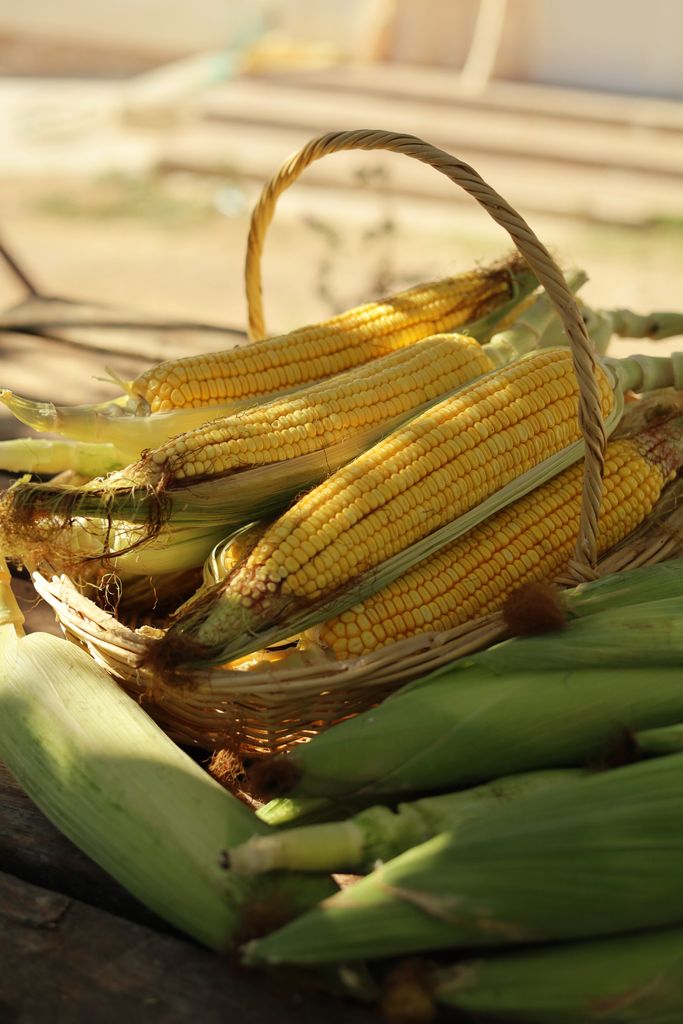
Yellow maize.
Biofortification: Making staple foods more nutritious
Agricultural research is often measured in tonnes per hectare. But should a successful harvest be judged only by how much food it produces, or also by how well that food nourishes the people who eat it?
Biofortification brings this question into crop improvement.
It involves developing food crops with higher levels of essential micronutrients, including provitamin A, iron and zinc. Unlike conventional food fortification, which adds nutrients during processing, biofortification aims to increase nutritional value through plant breeding or, in some cases, agronomic approaches.
For African countries where diets depend heavily on a limited number of staple foods, the approach offers an opportunity to address hidden hunger alongside agricultural production.
Orange-fleshed sweet potato: A particularly important example
The development of orange-fleshed sweet potato varieties rich in beta-carotene, which the body can convert into vitamin A, demonstrates how agricultural research can connect crop science with nutrition and public health.

Orange-fleshed sweet potato.
Working with national research organizations and other partners, the International Potato Center and HarvestPlus have supported the development and dissemination of vitamin A-rich sweet potato varieties in African countries.
The evidence extends beyond laboratory measurements. Research reviewed in the Annals of the New York Academy of Sciences in 2017 examined biofortified sweet potato in Uganda and Mozambique and provitamin A maize in Zambia. It documented evidence that these crops could improve vitamin A intake and status, while highlighting the importance of effective delivery and adoption strategies.
HarvestPlus reports that orange-fleshed sweet potato varieties have been released in numerous African countries and that studies have found nutritional benefits among regular consumers.
What makes biofortification different?
Its potential lies in incorporating nutritional value into food that people already eat.
If farmers grow a biofortified variety that suits their production conditions, and households consume it as part of their regular diet, the nutritional benefit can be delivered through the food system without requiring every consumer to purchase a separate fortified product.
However, adoption cannot be assumed. Consumers may prefer the taste, colour, texture or cooking characteristics of familiar varieties. Farmers must also be able to obtain quality planting material, and nutritional interventions need to complement wider efforts to improve dietary diversity and access to basic healthcare in the most remote places.
The next research frontier
Biofortification also raises questions about how nutritional traits can be combined with yield, disease resistance, climate resilience and consumer preferences.
For example, a nutritious variety that performs poorly in a farmer’s field may not be adopted. Similarly, a high-yielding crop may fail to deliver its nutritional promise if its taste or cooking qualities discourage consumption.
For Africa, this means treating nutrition as a core objective of agricultural innovation rather than an issue to be addressed only after crops leave the farm.
Digital agriculture: Turning research into decisions farmers can use
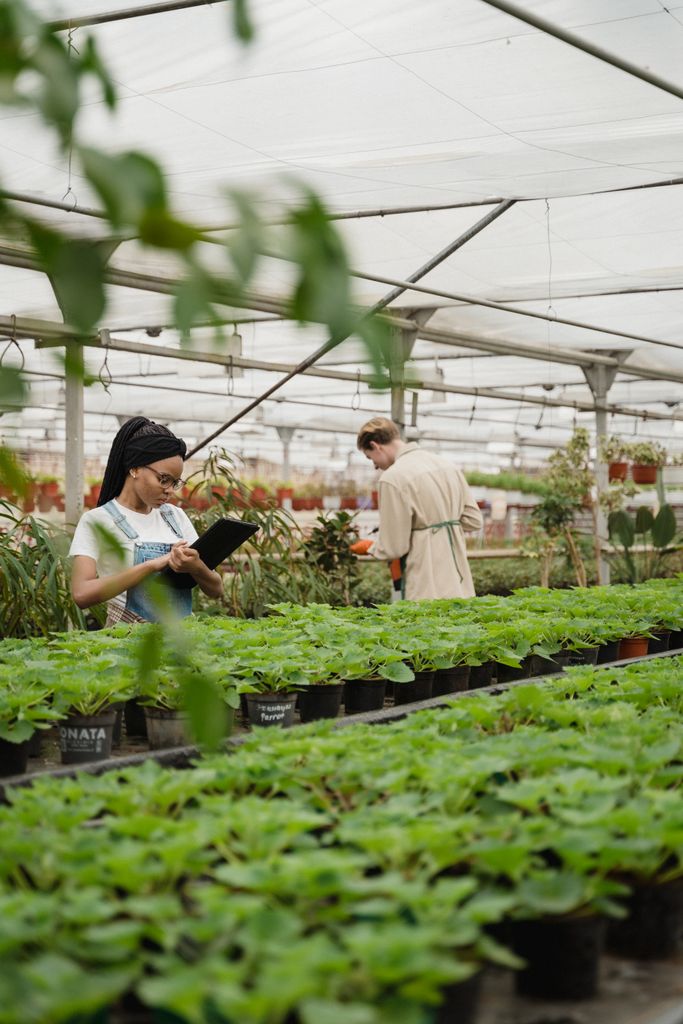
A research discovery has limited value if it remains in a research paper, a laboratory or an experimental plot. Farmers need to know what to plant, when to plant, how to manage pests, how much fertilizer to apply and how to respond when weather conditions change.
Digital agriculture offers new ways to translate research knowledge into practical decisions.
It includes mobile advisory applications, weather services, digital extension, remote sensing, satellite-based monitoring, field-data platforms and decision-support tools that help farmers and extension workers apply research to particular production conditions.
The most valuable innovations do not simply put information on a phone. They help farmers decide what to do, when to do it and whether the decision makes economic sense.
Evidence from Nigeria’s maize farms
The Nigerian site-specific nutrient management study discussed earlier illustrates this potential. Its digital tool enabled extension agents to produce recommendations tailored to individual farmers’ fields, helping them make better-informed decisions about nutrient management and fertilizer use. The three-year trial involving 792 farmers demonstrated measurable improvements in management practices and, in one treatment, yields and revenue.
A separate study published in 2025 examined RiceAdvice, a mobile advisory application designed to support rice production. Using data from 795 farmers in Ebonyi State, the researchers reported that adoption was associated with an average yield increase of 1,907 kilograms per hectare compared with non-adopters.
These studies demonstrate that digital advisory tools can support agricultural productivity when they deliver relevant recommendations and are backed by appropriate training and extension services.
The real opportunity is precision, not merely connectivity
A farmer who receives a generic message about fertilizer application may gain little if the recommendation does not account for local soil conditions, the crop variety, rainfall or input prices.
A farmer who receives a recommendation tailored to the field, together with information about expected costs and returns, may be better positioned to make a practical decision.
This is where digital technology and agricultural research intersect. Digital platforms can help deliver research findings, collect field information and improve the feedback between researchers, extension workers and farming communities.
But technology alone is not enough.
Farmers need reliable network access, affordable devices where required, information in languages they understand, and opportunities to ask questions. Women and older farmers, as well as people with limited literacy or digital skills, must not be excluded.
Digital advice must also be accurate and updated as conditions change. Poor recommendations can spread just as quickly as good ones.
What these research breakthroughs reveal
These seven areas share a common thread: each seeks to solve a practical agricultural problem by connecting science with the realities of farming.
- Climate-resilient crops — Varieties better suited to changing local growing conditions.
- Genome editing — More targeted approaches to developing useful crop traits.
- Biological pest control — Ecological approaches that can reduce crop damage and support soil and livestock systems.
- Soil science and precision nutrition — Field-specific nutrient recommendations and better soil management.
- Underutilised crops — Diversified food systems built around locally adapted crops and traditional knowledge.
- Biofortification — Staple crops with improved nutritional value.
- Digital agriculture — Timely, tailored advice supported by field data and research.
The missing link: Why promising research innovations do not always transform farming
These research areas demonstrate that agricultural science is expanding the range of solutions available to African farmers. But they also expose a persistent gap between developing an innovation and achieving widespread impact.
A new crop variety can pass research trials and receive regulatory approval without becoming widely available to farmers. A biological pest-control system can perform well in a study but remain difficult to adopt if companion-plant seeds are unavailable. A digital advisory application can provide accurate recommendations yet fail to reach farmers who lack connectivity or extension support.
This is not a minor implementation issue. It is central to whether research delivers its intended benefits to the last-mile users.
Research funding must support the full journey
Agricultural research requires sustained investment in laboratories, field trials, long-term breeding programmes, soil analysis, disease surveillance and building the capacity of scientists and national systems.
But funding must also cover the steps between discovery and adoption: seed multiplication, demonstration plots, extension, regulatory processes, processing technology and market development.
The CGIAR research system’s 2025–2030 portfolio places crop improvement, climate adaptation and food security within a wider research and innovation agenda. Its breeding programmes also emphasize better use of data and improved alignment between breeding priorities and farmers’ needs.
For African governments, donors and research organizations, the implication is clear: investment in discovery must be matched by investment in delivery.
Farmers must help define what counts as success
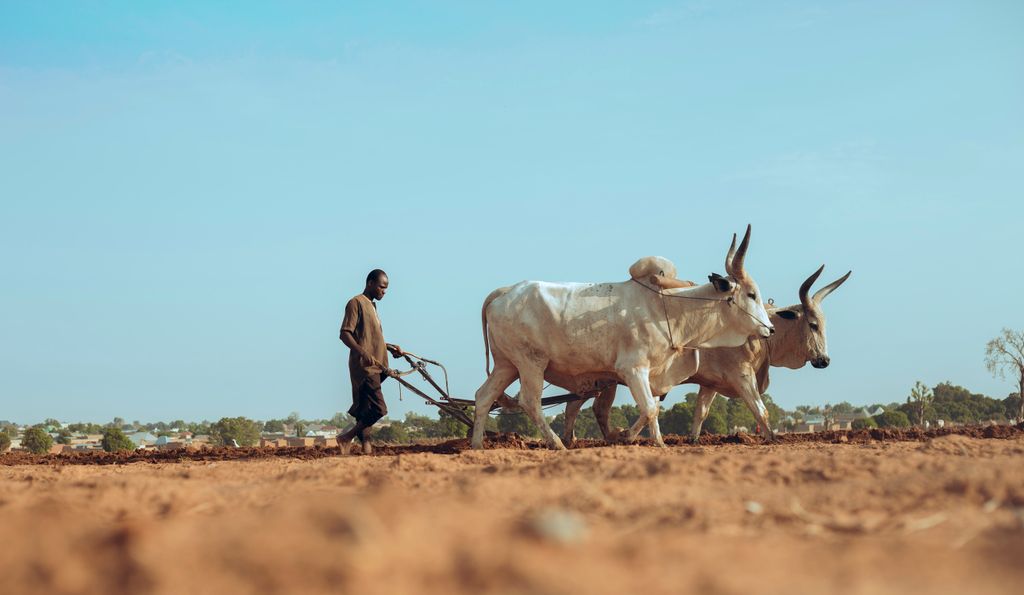
Farmer ploughing with cows on the field.
Scientists may prioritize yield, disease resistance or nutritional content. Farmers may also care about seed price, labour requirements, post-harvest, processing, access to buyers and the risk of losing money.
Those priorities are not competing definitions of agricultural progress. They are interconnected conditions for adoption.
A useful illustration comes from a 2025 study in northern Nigeria that evaluated seed trial packs and other interventions designed to encourage farmers to adopt improved crop varieties. In its cluster-randomized trial, seed trial packs increased adoption of promoted varieties by 42–44% of farmers. The promoted varieties also achieved higher yields than traditional varieties in the study’s first season: 16–25% more for maize and 70% more for cowpea, with gains persisting into the second season.
The result suggests that allowing farmers to try improved seeds can help bridge the gap between awareness and adoption. It also shows why farmers’ own assessments of production, processing, marketing and consumption characteristics matter.
African research institutions need stronger, sustained capacity
Africa needs the infrastructure and expertise to set its own research priorities, maintain genetic resources, conduct trials, develop technologies and evaluate results.
This means supporting national agricultural research institutes, universities, regional research networks, laboratories and the next generation of African scientists.
International partnerships can accelerate progress, but African institutions must remain central to determining which problems receive attention and how solutions are adapted to local conditions.
The ability to develop a technology is important. The ability to maintain, improve and adapt it over time is equally important.
Markets and policy can determine whether innovations survive
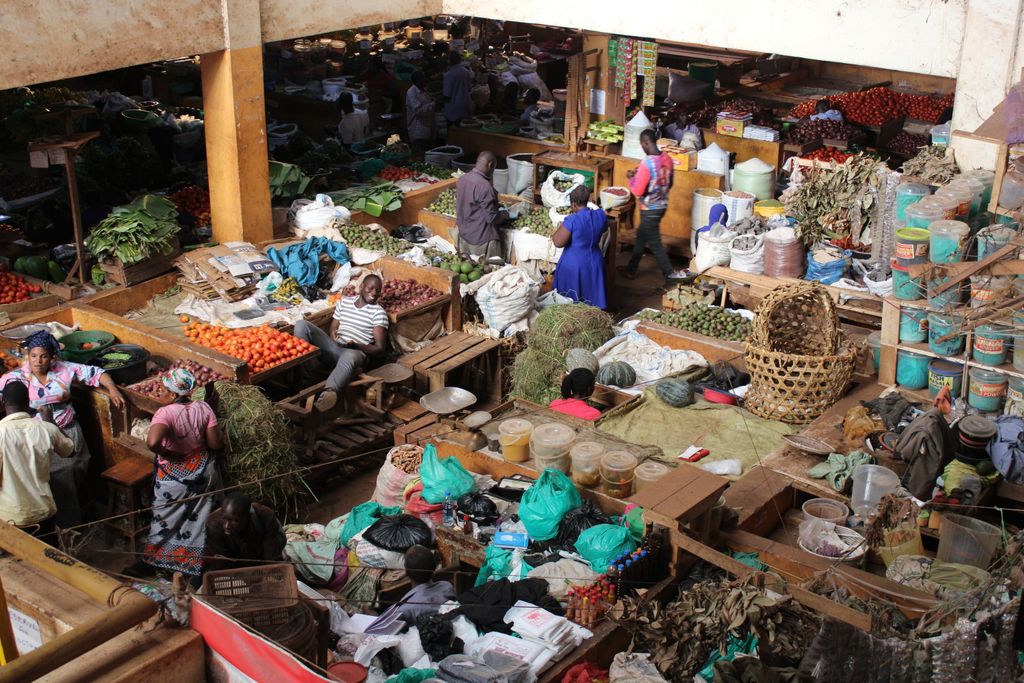
A produce market.
Farmers are unlikely to continue growing a crop simply because research shows it is promising. They need buyers, competitive prices and confidence that growing it will be worthwhile.
The same principle applies to underutilized crops, biofortified foods and new biological inputs. Their success depends partly on processors, retailers, food businesses, seed companies, public procurement and consumer demand—the whole market system.
Policies that support quality seed systems, fair market access, agricultural extension and responsible innovation can help research move beyond isolated success stories.
Research impact must be measured honestly
Counting publications, patents, varieties released, workshops held or farmers trained provides useful information, but these indicators do not necessarily establish that agricultural conditions have improved.
Stronger impact assessment asks:
- How many farmers continue to use the innovation after initial support ends?
- Does it improve yields, income, nutrition or resilience under real farming conditions?
- Are the benefits affordable and accessible to women, young people and resource-limited farmers?
- Does the innovation reduce losses or environmental harm?
- What are the costs, trade-offs and unintended consequences?
- Can the results be reproduced in other locations and seasons?
These questions help distinguish research potential from demonstrated impact.
They also make agricultural research more accountable to the farmers and communities it is intended to serve.
Africa’s agricultural future will be built by connecting discovery with delivery
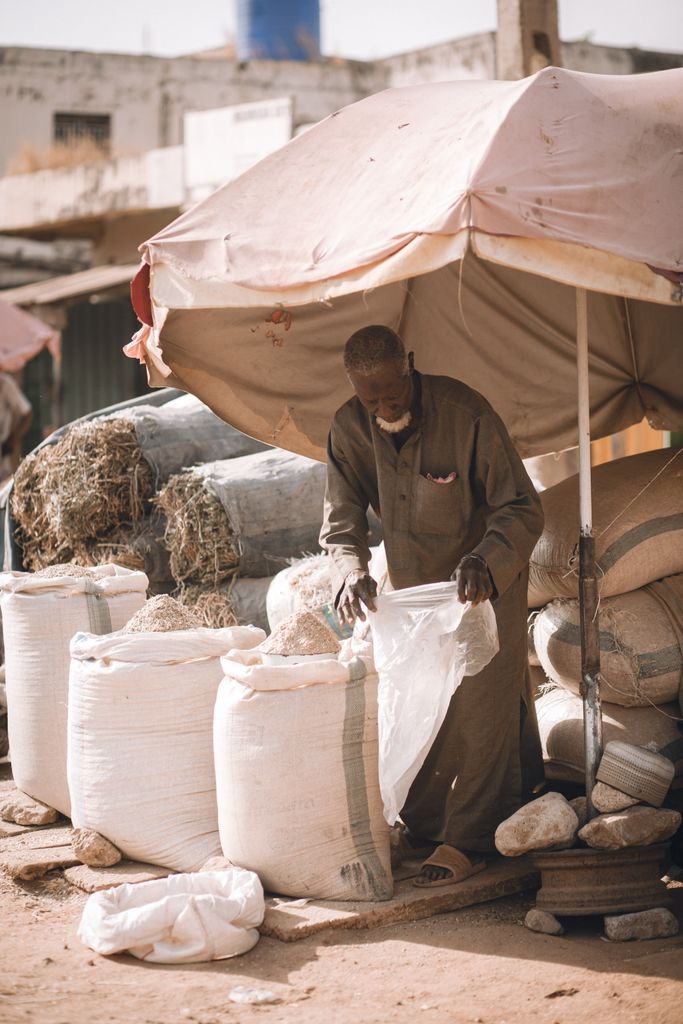
Animal feed trader in the market.
The highlighted research areas gears toward a broader transformation in how agricultural challenges are understood and addressed.
Climate-resilient breeding seeks to prepare crops for changing environmental conditions. Genome editing expands the tools available to breeders. Biological pest management draws on ecological relationships to protect harvests. Soil research helps farmers use nutrients more effectively. Underutilized crops offer opportunities to diversify food production and diets. Biofortification connects agriculture with nutrition. Digital tools help translate research findings into practical decisions.
None of these innovations is a universal solution. Each has limitations, costs and conditions under which it works best. Some have substantial evidence of practical benefits; others remain developing technologies whose potential must be tested further.
Together, however, they demonstrate the breadth of research work taking place to strengthen African agriculture.
The next stage requires more than producing additional innovations. It requires research priorities shaped by farmers’ needs, stronger African research institutions, reliable seed and input systems, effective extension, functioning markets and investment that follows innovations from experimentation to sustained use.
It also requires a more ambitious understanding of agricultural success. The objective should not simply be to produce more food, but to build farming systems that are productive, nutritious, environmentally sustainable and economically viable.
Ultimately, Africa’s agricultural transformation will be determined not by the number of technologies developed or breakthroughs announced, but by the number that make a measurable, lasting difference in farmers’ fields, household diets and rural economies across the continent.